
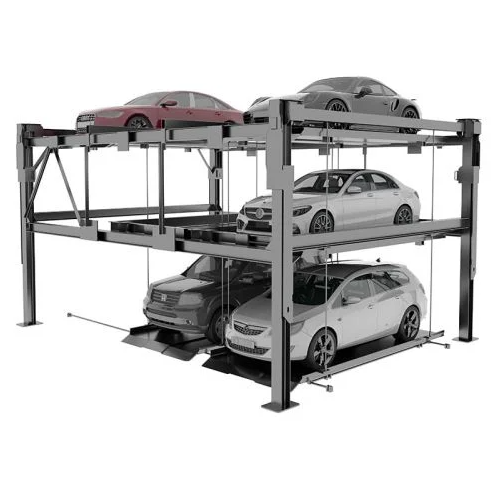
Why We Recommend AGV Parking Systems
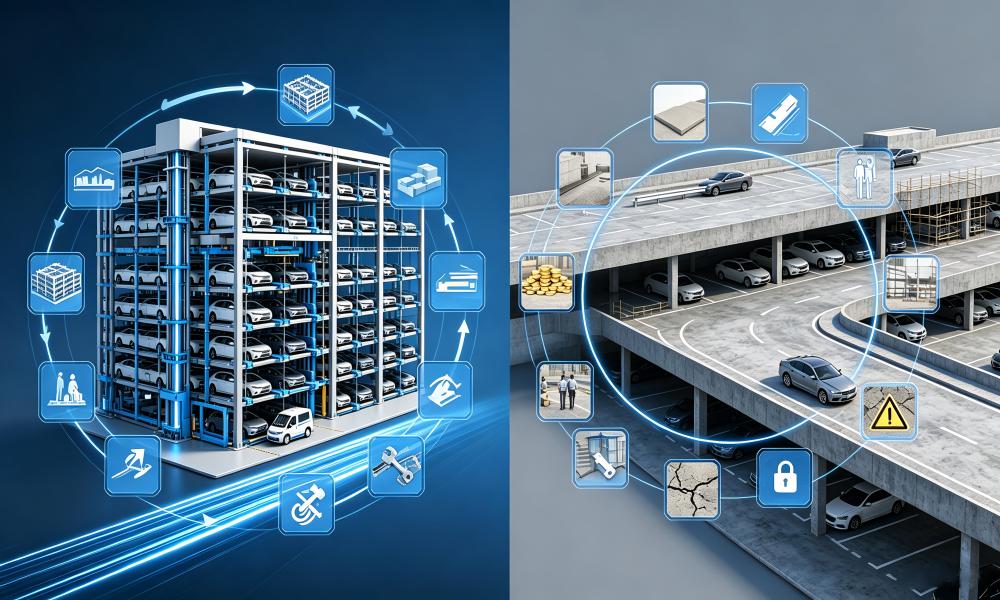
1. More Spaces per Unit Area — Not "Squeezing Out a Few More," But Eliminating Spatial Waste at the Root
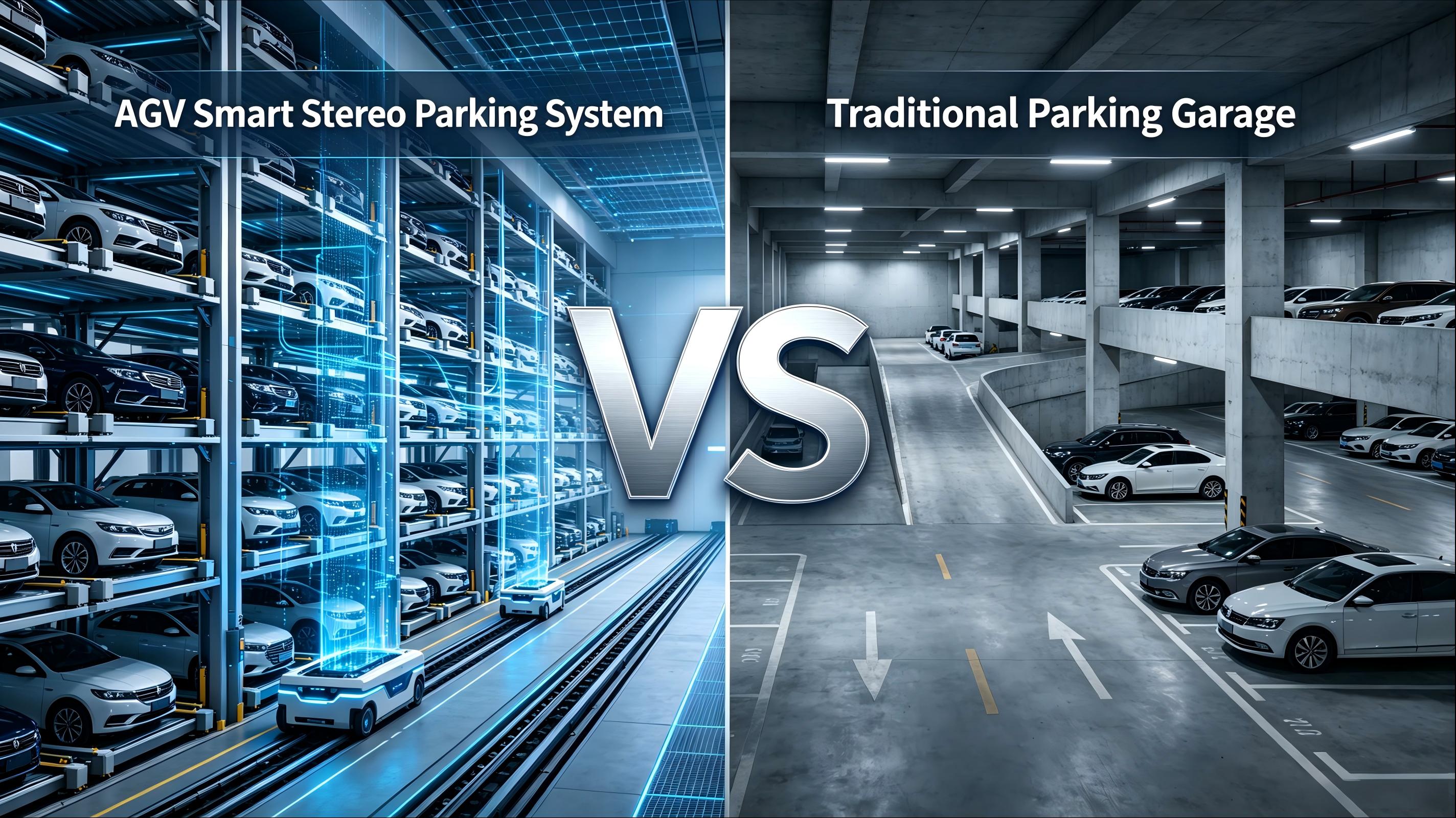
The largest hidden cost of a conventional parking garage is the space paid for "human driving": traffic lanes, turning radii, door-opening clearance, and low-speed circling while searching for a spot — every one of these eats up area that could otherwise become parking spaces. An AGV (Automated Guided Vehicle) parking system eliminates all of this "driving redundancy." A parking robot does not need drivers to open doors and get out, so stalls can be placed tightly next to one another; no driving aisles are required, the number of aisles is drastically reduced, and robots travel freely between densely arranged stalls, with multi-level stacking also supported.
In concrete data, the gain from this elimination is structural. The area per stall can be compressed from roughly 30–40 m² in a traditional garage to about 15 m². At a hospital project in Shanghai, the number of parking spaces increased by 181%, while the area per stall shrank by 50%–60%. Figures vary by project — some report a 30%–50% increase, others a 40%–60% rise in the number of vehicles parked per unit area — but the direction is consistent: on the same land, an AGV system delivers significantly more parking capacity than self-parking. For prime locations where land is precious and the parking shortfall is rigid, this is not "optimization"; it is fitting an order-of-magnitude more parking capacity onto the same plot.
2. Smart, Convenient Parking and Retrieval — Removing "the Most Anxiety-Inducing Part of Driving" from the Process
The pain points of conventional parking fall into three areas: circling to find a spot, reversing into the stall, and walking through the garage trying to remember where you parked. The intelligent dispatching system of an AGV parking system removes all of these steps from the user side.
Drivers simply get out at the entrance/exit handover zone and leave. The system automatically detects vehicle dimensions, assigns a stall, and dispatches a robot to transport the car. To retrieve, the driver enters the license plate on a screen; a robot brings the car to the pickup bay, and when the gate rises the car faces directly toward the exit — drive straight out, no reversing or turning around. In some scenarios, pickup can even be reserved by phone, so the vehicle is already in place by the time the driver reaches the pickup zone.
This means "parking" is reduced for the driver to a single action: hand over the car at the entrance, pick it up at the entrance. New drivers no longer face the stress of reversing into a stall, and leaving no longer means circling through the garage looking for their car. The value of intelligence here is not about showing off; it is about restoring parking from a driving skill back into a skill-free service.
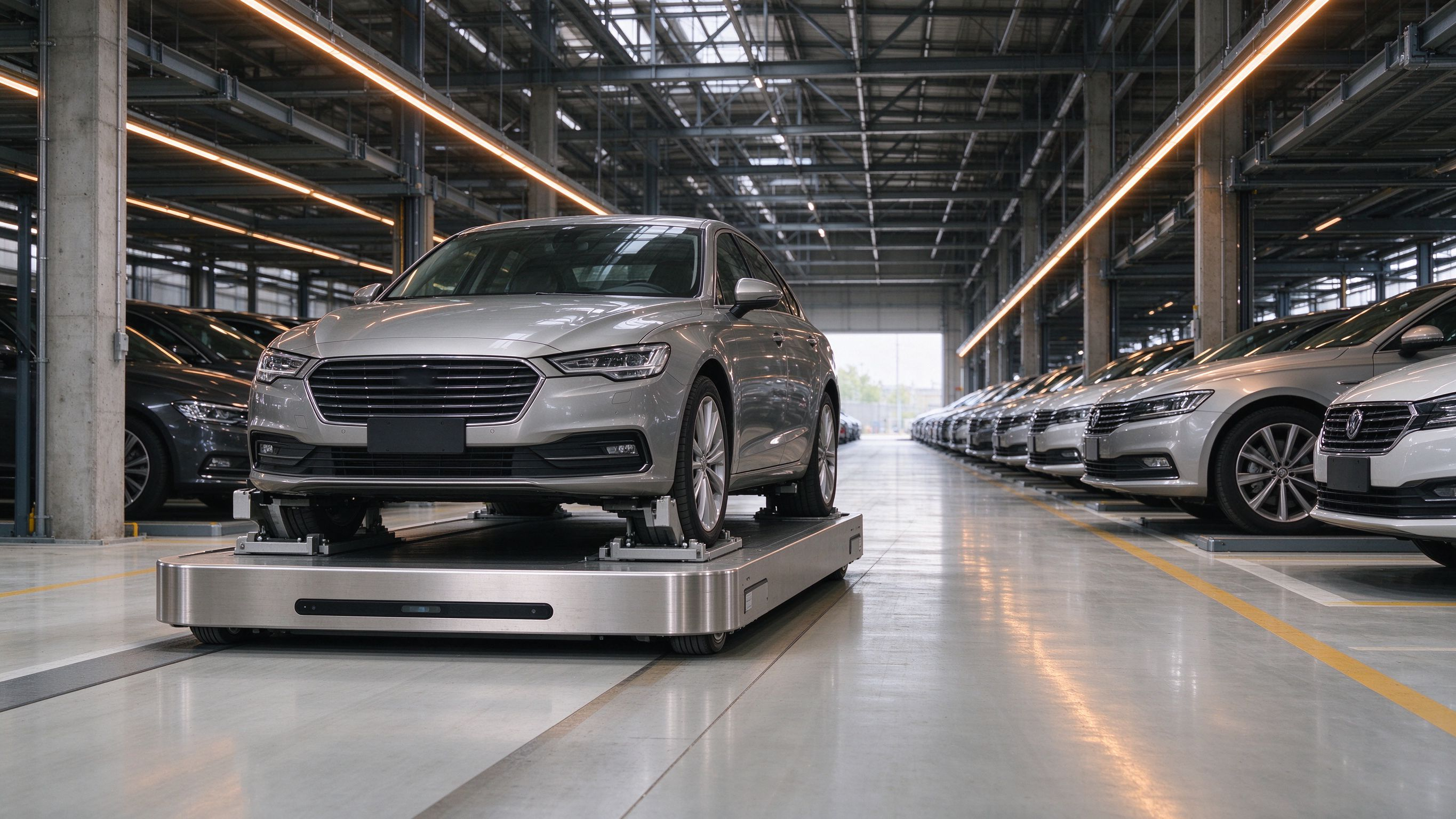
3. Premium Positioning — Matching the Spatial Quality of "People-Car Separation, Contactless Access," Not Merely Equipment Grade
The reason AGV parking systems are accelerating into high-end commercial complexes, top-tier hospitals, transportation hubs, and luxury residential buildings is that the spatial experience they deliver is structurally aligned with the positioning of these scenarios.
With complete people-car separation, drivers never enter the garage interior. Lighting and ventilation in the parking area can be switched on only as needed, or even kept off most of the time, significantly cutting energy consumption and carbon emissions. Conventional garages require large numbers of security, cleaning, and guidance staff, whereas an AGV garage with 250–300 parking units needs only 1–2 operators for routine monitoring and emergency response. For premium office towers, hotels, and luxury residences, AGV parking delivers a quiet, orderly arrival experience free of unrelated personnel walking through — the same spatial language as the project itself. The 46-story luxury residential tower at Brickell House in Miami adopted one of the world's largest AGV parking systems at the time, confirming the fit of this solution for high-net-worth properties.
4. High Reliability — the Real Advantage Is Not "Never Failing," but That a Single Point of Failure Does Not Paralyze the Whole System
This is one of the most underestimated structural advantages of AGV parking systems over traditional mechanical parking equipment.
The failure logic of conventional mechanical equipment (lifting-sliding, aisle-stacking, etc.) tends to be systemic: one stuck carrier plate or one failed lift can take down an entire aisle — or even the whole parking zone — making parking and retrieval impossible. AGV parking systems use a distributed dispatching architecture: each robot makes autonomous decisions based on local information, and the system does not depend on a single central dispatcher. If any one AGV fails, its task is simply reassigned to other available vehicles; the whole system never comes to a halt. A Ningde AGV parking garage that has run for a year and a half directly confirms this: "low failure rate, small impact scope, no disruption to parking or retrieval," with a single parking or retrieval cycle completed in no more than 150 seconds.
For users, the significance of this reliability logic is this: the garage's service capacity does not reset to zero because of one abnormal robot. During peak hours, that is a substantive guarantee, not a theoretical parameter.
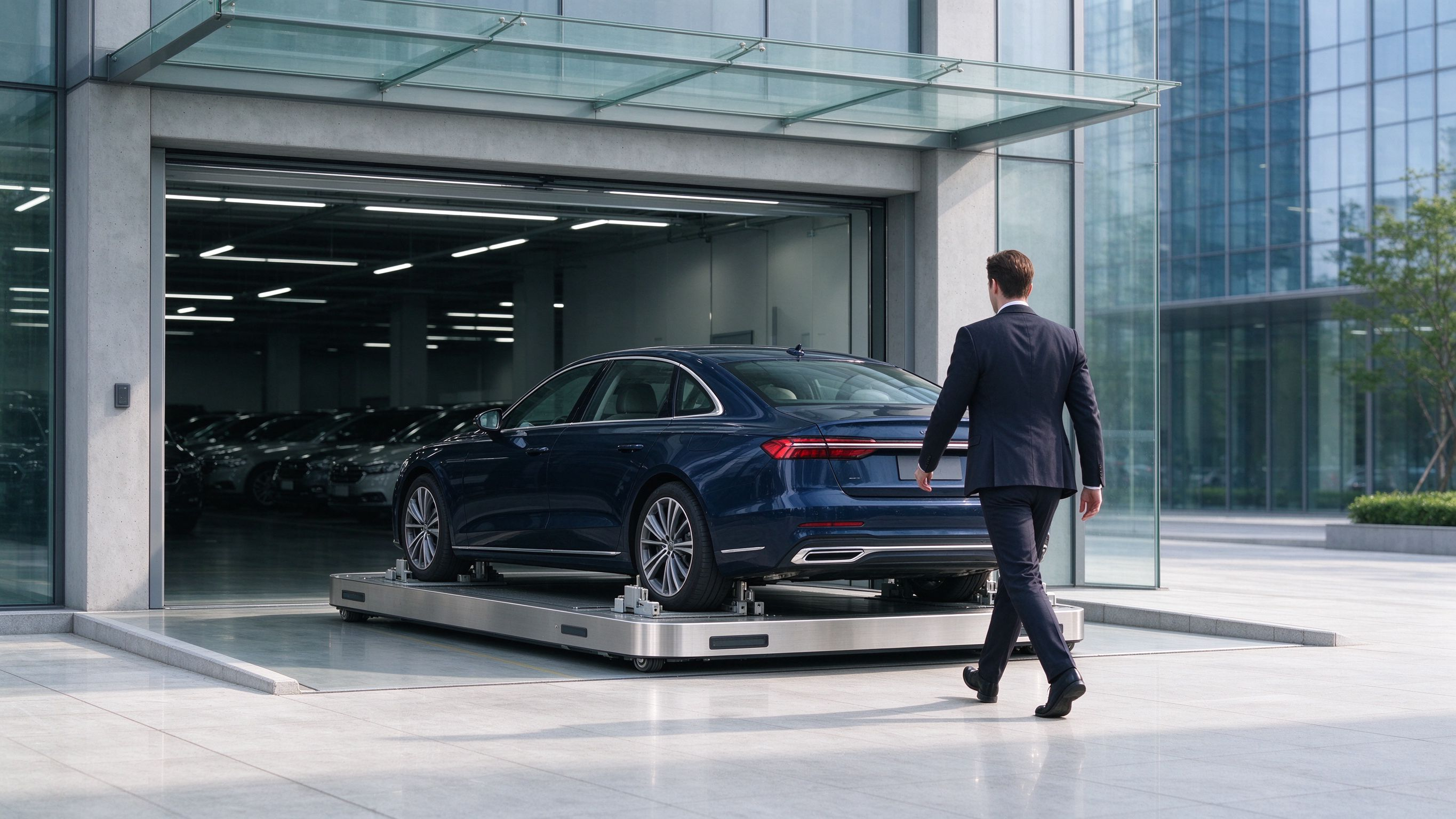
5. The Core Reason to Choose an AGV Parking System
In one sentence: AGV parking replaces the "uncertainty" of human driving with the "certainty" of robots.
The efficiency ceiling of a conventional parking lot is limited by every driver's skill, habits, and mental state. An AGV parking system transforms parking from "a driving operation performed by a person" into "a transport task dispatched by a system." The leap in stalls per unit area, the pull-up-and-go convenience at the entrance, the spatial order required by premium scenarios, and the non-propagating reliability of a distributed architecture — all of these ultimately come from the same source: once drivers no longer need to drive inside the garage, space, time, and reliability are redistributed all at once.
Therefore, choosing an AGV parking system is not about adding a bit of smart equipment to the existing way of parking; it is replacing a human-labor logic with a systems logic. In scenarios where land is scarce, experience is sensitive, and operational quality demands are high, this is currently the most reasonable efficiency choice.