Leave Your Message
Picking the right Garage Elevator Lifts can really change the game for your workshop, dealership, or personal collection. But here’s the thing—focusing only on lifting capacity or price can get you into trouble down the line. It’s super important to have a clear picture of safety, installation ease, service access, and what your ongoing operating costs will look like.
Bob O’Gorman, who used to be the president of the Automotive Lift Institute, always used to say, “A lift is only as safe as its installation, inspection, and how you use it.” That wisdom still holds true whether you’re looking at two-post, four-post, scissor, or parking lift systems. The right lift should suit your vehicle’s weight, wheelbase, ceiling height, and how much you’re lifting on a daily basis. It also needs to have sturdy mechanical locks, stable platforms, straightforward controls, and clear emergency procedures. And don’t forget about certifications—be sure to check relevant documents like ANSI/ALI standards, CE markings, or other regional certifications.
This guide gives you an overview of some of the top Garage Elevator Lifts available for various markets and needs. We’ve looked at products from well-known brands like BendPak, Rotary, Nussbaum, and Stertil-Koni. But here’s the thing: just because a product makes performance claims doesn’t mean it’ll perform well in real-world conditions. Factors like uneven flooring, tight spaces, humid climates, or difficulty finding replacement parts can really influence your decision.
Of course, no one’s rankings are perfect. Some folks prefer a compact scissor lift, while others might need a four-post system for extra storage. It’s always a good idea to have a local technician check out your space before making a purchase—that step sometimes gets skipped, but it can end up costing a lot if overlooked. This comparison is meant to be a helpful starting point, keeping in mind that your budget, local regulations, and availability of maintenance support can all vary depending on where you are.
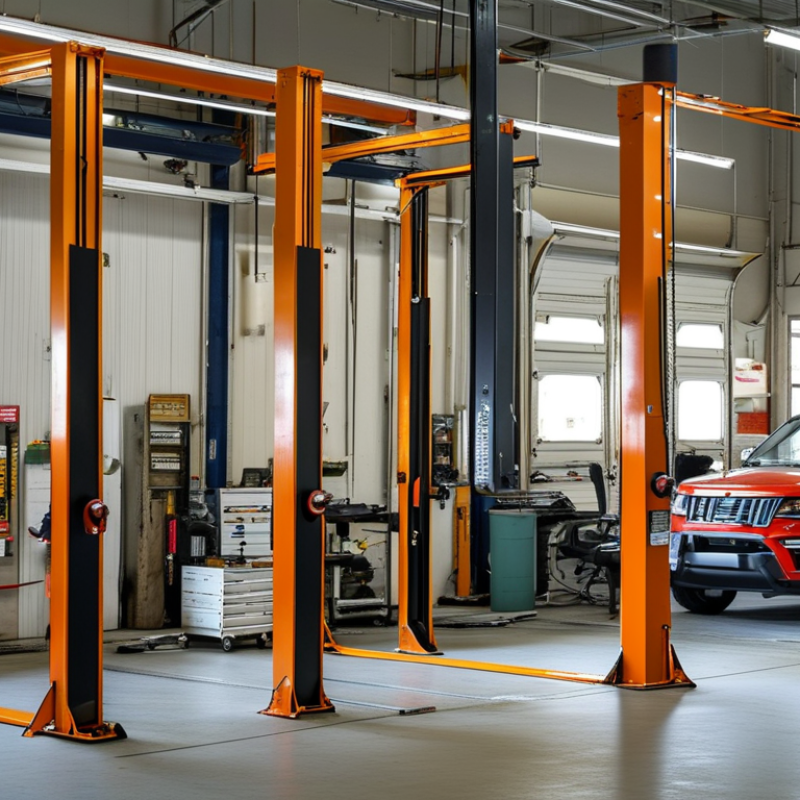
Choosing among Garage Auto Storage Lifts starts with the vehicle and workspace, not the product photograph. A 2-post lift leaves excellent access beneath the car, making tire, brake, and suspension work easier. It needs a stable concrete floor and careful arm positioning. Clearance matters. A tall SUV may approach the ceiling quickly.
A 4-post lift supports the tires on long platforms, offering practical storage for a second vehicle. It feels stable and suits garages where underbody access is occasional. Scissor lifts use a compact rising platform. They save visual space, but some designs limit access along the vehicle’s centerline. Check minimum and maximum lifting heights before buying. Small differences become frustrating during real repairs.
Parking stackers lift one vehicle above another, turning unused vertical space into parking capacity. They are valuable in narrow garages, yet column width and ramp length can affect daily use. Review rated load capacity, platform dimensions, locking systems, emergency lowering, and local installation requirements. A qualified installer should inspect the slab and confirm vehicle compatibility. Never rely on capacity numbers alone.
The wrong lift can fit badly. Measure twice. Also consider door clearance, lighting, drainage, and walking space. Some buyers focus on lifting height and forget the lowered platform. That oversight is common, and expensive. Routine inspections, balanced loading, and clear operating instructions support safer long-term use.
| Lift Type | Typical Rated Capacity | Typical Vehicle Clearance | Common Platform or Width Range | Typical Installation Requirement | Best Use | Main Advantages and Limitations |
|---|---|---|---|---|---|---|
| 2-Post Lift | Approximately 3,600–5,500 kg (8,000–12,000 lb) | About 1.5–1.9 m (59–75 in), depending on the model and vehicle height | Overall width commonly about 3.3–3.8 m (130–150 in); adjustable arms support different wheelbases | Requires a reinforced concrete slab. Many models need around 100–150 mm (4–6 in) of suitable concrete, but the exact requirement must follow the installation manual and local code. | Professional mechanical repair, wheel service, brake work, suspension access, and underbody maintenance | Provides excellent access to the wheels and underbody while using relatively little floor space. It requires careful vehicle positioning and adequate ceiling height. |
| 4-Post Lift | Approximately 3,600–6,800 kg (8,000–15,000 lb) | About 1.5–2.0 m (59–79 in); higher-rise configurations may provide more clearance | Runway width commonly about 2.5–3.0 m (98–118 in); overall width is often about 3.0–3.5 m (118–138 in) | Usually easier to position than a 2-post lift. A level, load-bearing floor is still essential, and some models may require anchoring or wheel stops. | Vehicle storage, detailing, alignment-related work, long-term parking, and lifting heavier vehicles | Offers strong stability and convenient drive-on loading. It generally takes more floor space and may provide less direct access to the center of the underbody. |
| Scissor Lift | Approximately 2,700–5,000 kg (6,000–11,000 lb) | Low-rise models: about 0.5–1.0 m (20–39 in); mid-rise models: about 1.0–1.5 m (39–59 in) | Platform length commonly about 1.8–2.2 m (71–87 in); platform width often about 0.6–0.75 m (24–30 in) per side | Needs a stable, level floor and sufficient clearance for the folded lift. Recessed or flush-mounted models may require construction work and drainage planning. | Tire changes, brake servicing, oil changes, detailing, and garages with limited ceiling height | Compact footprint and a relatively low closed height make it suitable for many private garages. The central lifting structure can restrict access to some underbody areas. |
| Parking Stacker | Approximately 2,000–3,600 kg (4,400–8,000 lb) per platform, depending on configuration | Usually about 1.5–1.9 m (59–75 in) for the lower parking space; total raised height commonly about 3.0–3.8 m (118–150 in) | Platform width commonly about 2.4–2.7 m (94–106 in); platform length often about 4.8–5.5 m (189–217 in) | Requires a level reinforced floor, adequate ceiling height, vehicle-length clearance, and safe access to controls. Local fire, building, and electrical requirements may apply. | Doubling parking capacity in private garages, residential developments, workshops, and commercial parking areas | Maximizes vertical parking capacity and can reduce land use. It is primarily a storage solution rather than a full-service repair lift, and vehicle dimensions must be checked carefully. |
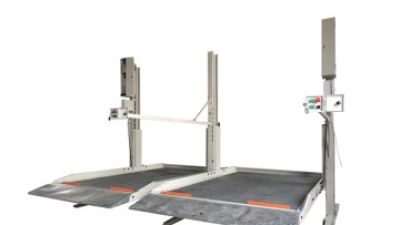
Many home garages now need to accommodate more than one vehicle. The Federal Highway Administration’s 2022 National Household Travel Survey reported an average of approximately 1.9 vehicles per household in the United States, highlighting the growing need for efficient residential parking. A high-quality two-post parking system can convert unused vertical space into a practical second parking level, making it suitable for households with both an SUV and a sedan.
This Simple Parking System provides two parking levels and supports up to 3,200 kg, offering sufficient capacity for many passenger vehicles and midsize SUVs. Its maximum lifting height of 2,100 mm should be checked against the garage’s clear ceiling height, lighting, doors, and overhead storage before installation. Vehicle dimensions should also be measured carefully, including roof accessories, mirrors, and trunk or hatch clearance. The lower vehicle remains accessible for normal use, while retrieving the upper vehicle requires moving the lower car first, so owners should plan enough driveway space for temporary repositioning.
Garage layout is equally important. The lift should be installed on a suitable concrete floor with adequate clearance around the posts and vehicle doors. Since parking needs vary, customizable equipment dimensions can help accommodate different garage widths, ceiling heights, and SUV or sedan combinations. Professional installation, routine inspection, and compliance with applicable local safety requirements are essential for dependable daily operation.
Measure the widest body point, not the wheel arches. Include tire width, mirror-to-mirror distance, and door-opening space. A 70–84 inch platform may fit many vehicles, but not every crossover.
It may suit standard vehicles. Roof racks, antennas, and raised tailgates reduce usable height. Measure the tallest vehicle, not the average one. Measure twice.
Check ceiling height at several points. Record lighting, door tracks, beams, and overhead storage. A high ceiling can still provide poor working clearance.
Ask a structural engineer to inspect slab thickness, concrete quality, cracks, and reinforcement. Include vehicle weight, platform weight, and uneven loading. A solid-looking floor can still hide weakness.
Verify voltage, phase, breaker size, cable routes, and emergency isolation. A standard outlet is rarely sufficient. Local electricians should review the installation requirements.
Four-post lifts offer stable ramps and multiple locking positions. They work well for seasonal vehicles and compact garages. Check whether the raised vehicle blocks lights or doors.
Two-post lifts often provide useful wheel access. Scissor lifts can preserve floor space. Check capacity, arm reach, pad height, locking systems, and concrete requirements.
Choose suitable capacity and broad load distribution. Keep clear access around the battery area. Electric vehicles are changing workshop planning. The available data is still incomplete.
Compare cycle time, platform width, emergency lowering, drainage, and fire requirements. Daily traffic and operator training affect real performance. A large capacity number proves little.
Request structural calculations, maintenance intervals, spare-part information, installation exclusions, and independent conformity records. Check local requirements too. I would not trust a glossy specification sheet alone.
Choosing the right Garage Elevator Lifts requires evaluating both vehicle requirements and site conditions. Common options include two-post and four-post lifts for repairs and storage, scissor lifts for flexible access, and parking stackers for maximizing available space. Buyers should compare rated capacities, typically ranging from 6,000 to 18,000 pounds, while confirming that the lift width and clearance suit their vehicles. Compliance with recognized vehicle-lift standards, such as ANSI/ALI ALCTV and EN 1493:2010, is also essential for safe and responsible selection.
Before installation, assess ceiling height, floor strength, electrical supply, and available working space. Important safety features include mechanical locking positions, clearly defined load limits, stable lifting geometry, and emergency lowering systems. The best model depends on its intended use: long-term vehicle storage, routine repairs, electric vehicles, or commercial parking. A careful comparison of capacity, dimensions, safety systems, installation needs, and operating environment will help global buyers select a practical and dependable solution.